YES - Youth Empowerment Skills
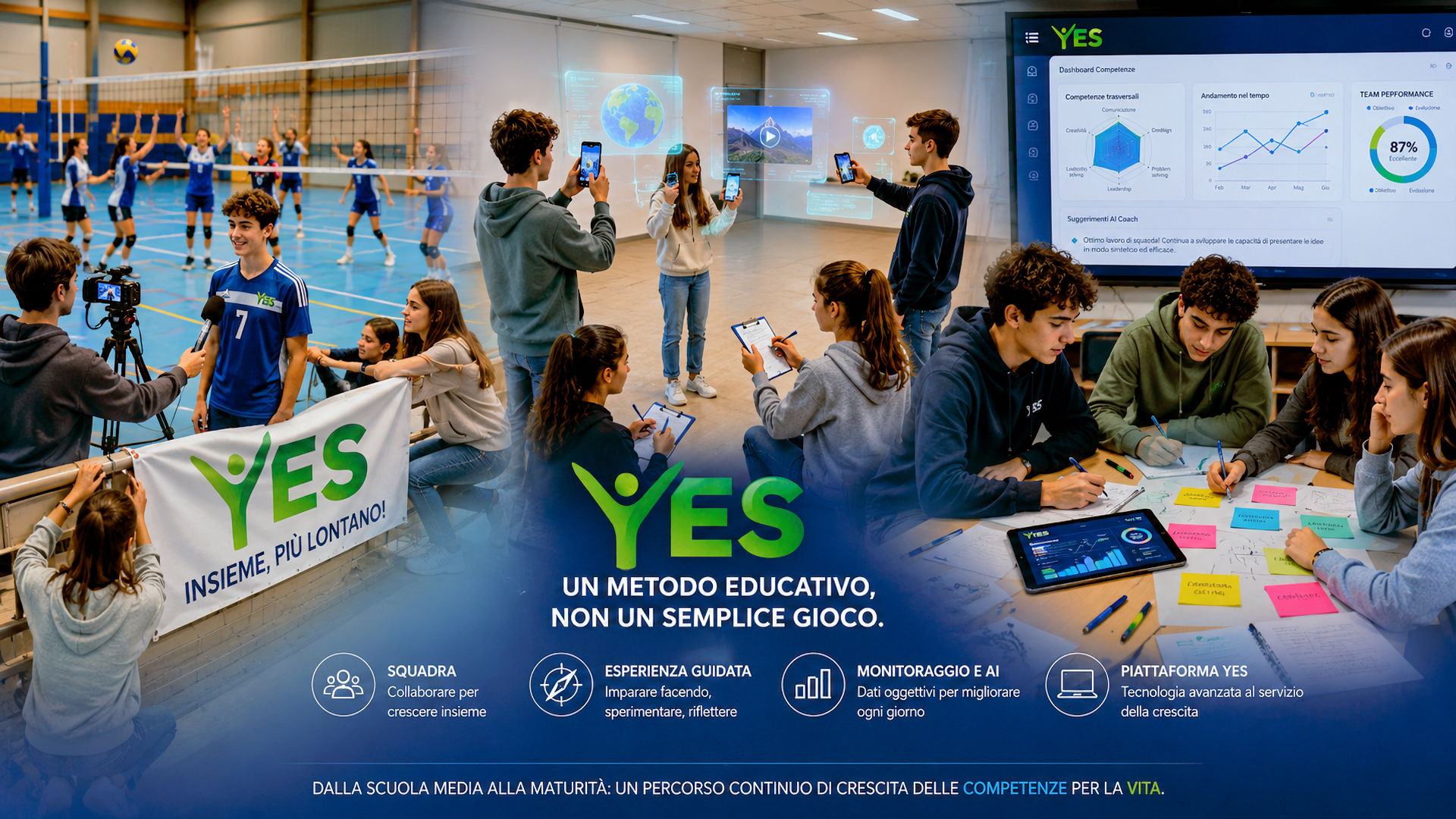
YES - Youth Empowerment Skills is an experiential educational method designed to help young people
become active participants in their own development. Through challenges, simulations and team-based experiences, YesGames
create opportunities to practise transferable skills and life skills: collaboration, leadership, communication,
problem solving, critical thinking, responsibility, creativity and the ability to work effectively with others.
The method is based on learning by doing: young people act, make choices, compare ideas, solve problems,
reflect on what happened and try again. Activities can be adapted to different ages, cultures, languages and learning contexts,
including schools, youth programmes, community settings, sport and non-formal education.
The yesthegame.com digital platform supports the experience with structured pathways, educational AI tools and
progressive monitoring. The aim is not to label or judge young people, but to help them recognise strengths, build confidence,
learn from mistakes and develop skills that can travel with them across education, work and everyday life.
support@yesthegame.com
Learn more about international partnerships and collaboration opportunities
What is YES - Youth Empowerment Skills
YES is a method. Challenge and competition are the means: they create engagement, participation and a reason for the team to act. The real substance lies in the learning journey — observing, choosing, collaborating, discussing, deciding, negotiating, planning, communicating, making mistakes, reflecting, trying again and gradually becoming more aware of how one contributes to a group.
Describing YES merely as a game is misleading. It would be like looking at the packaging without understanding what it contains. Play is the most spontaneous and natural way to engage a group; the educational method turns that experience into learning, awareness and the measurable development of skills that are highly valuable in the real world.
YES uses play and challenge to create a participatory learning environment in which young people are not passive recipients but active contributors. Experience, peer collaboration, reflection after action and the opportunity to turn mistakes into new attempts make learning concrete, memorable and connected with real situations.
The Yesgame as a Catalyst, Not an End in Itself
In YES programmes, play is not a pastime but a structured catalyst that brings to light behaviours, decisions, relationship patterns, organisational abilities, personal qualities and potential that often remain invisible in conventional classroom teaching.
When a group of young people has to choose a name, create a logo, prepare a presentation, negotiate a decision, take part in a simulation, produce content, resolve a conflict or defend a project, highly valuable educational evidence emerges: who listens, who leads, who mediates, who contributes ideas, who organises, who takes responsibility, who becomes discouraged, who withdraws and who improves over time.
The next stage is even more valuable: participants analyse their results and compare them with those achieved by other groups. This reveals what could have been done better and how much improvement is possible by examining the solutions and strategies used, in the same context, by teams that achieved stronger results.
This is where the value of YES lies: transforming apparently simple and engaging situations into opportunities for observation, practice and growth.
A Method for Every Stage of Youth Development
YES is designed to adapt to different stages of youth development and to different learning environments. It can be used with younger children, adolescents and older students in schools, youth centres, community programmes, sport, career-guidance initiatives, non-formal education, educational workshops and other group-based settings.
Naturally, the method is delivered differently according to age: the language, complexity of the tasks, required level of autonomy, duration of activities, role of adults, weight given to assessment and depth of the final reflection all vary.
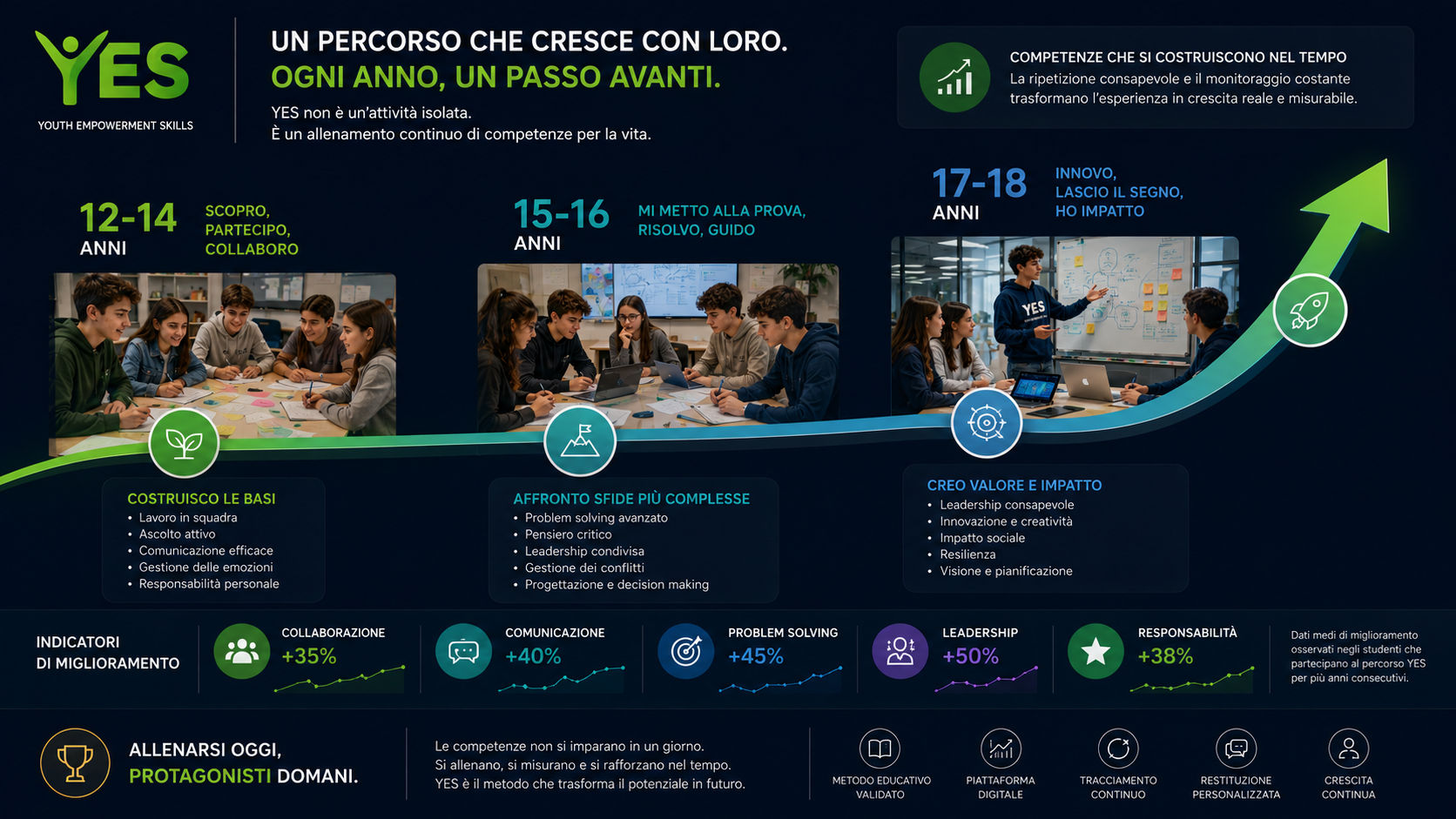
A single YES experience can be useful and stimulating because it gives young people a genuine opportunity to engage and compare approaches. The most tangible results, however, are achieved when the method is used consistently throughout their formative years.
As in sport, a single match can be exciting, but only progressive, continuous training that is observed and measured over time can produce real, tangible improvement.
Building Skills for Learning, Participation and Life
Knowledge matters, but young people also need opportunities to practise the skills that help them use knowledge in real situations. Communication, collaboration, decision-making, responsibility, problem solving, listening, leadership and constructive participation become stronger when they are exercised rather than merely described. As in sport, progress comes from practice, feedback, reflection and the opportunity to try again.
Becoming genuinely involved is not easy, especially during the formative years of youth. For this reason, YES uses gamification to create an engaging, non-judgemental environment in which young people can experiment freely, make mistakes, try again and improve without fear of grades or the consequences typically associated with real-life situations. The motivation comes from the desire to compete, compare themselves with others and test their own abilities.
Skills are developed primarily through experience and through repeating that experience over time, exactly as happens in sports training. YES therefore delivers its greatest value when it supports young people continuously throughout their development, offering progressive and repeated experiences that become increasingly rich in content: a form of ongoing training that prepares them for the real challenges of life, while respecting each individual’s pace and personal characteristics.
YES can therefore work wherever young people learn and grow together: schools, youth organisations, community settings, sports clubs, associations, educational programmes and other environments in which teachers, educators, facilitators, coaches or other trusted adults can guide and support the experience.
yesthegame.com - The Platform: A Defining Component
YES is not simply the organisation of group activities or competitions. Anyone can run games, tournaments, simulations and workshops. They become part of the YES ecosystem only when they are embedded in a designed, guided and monitored educational framework supported by a platform that ensures methodological consistency, continuity, progress measurement and quality standards.
The yesthegame.com platform is not merely a digital repository. It is the environment that provides access to the programme library, delivery frameworks, materials, assignments, interactions and, above all, the criteria used to observe, assess and monitor the activities carried out.
Without technical monitoring of outcomes, even a well-organised activity risks remaining little more than a game.
With the platform, the game becomes an educational environment that can be observed, measured, compared and progressively improved.
YesLibrary: An Open Library of Learning Experiences
The YES method is not limited to a fixed number of YesGames, nor is there a definitive and unchangeable list. YesGames are formats, scenarios and experiential environments that can grow, evolve and adapt to different educational objectives, age groups, contexts, available time, logistical conditions, participant numbers and the needs of the school or organisation using them.
YesLibrary is the programme library: an organised collection of models, content, rules, assignments and scenarios that enables activities to be designed in accordance with the YES method and adapted to different communities and learning contexts. Some YesGames focus more strongly on communication, others on project work, negotiation or creativity, while others address citizenship, conflict management, sport, digital skills or career guidance.
The method is not confined to a predetermined number of YesGames. It is more accurate to think in terms of families of YesGames, with progressive activities and programmes that can be designed and adapted over time to suit each specific context.
Examples of YesGames
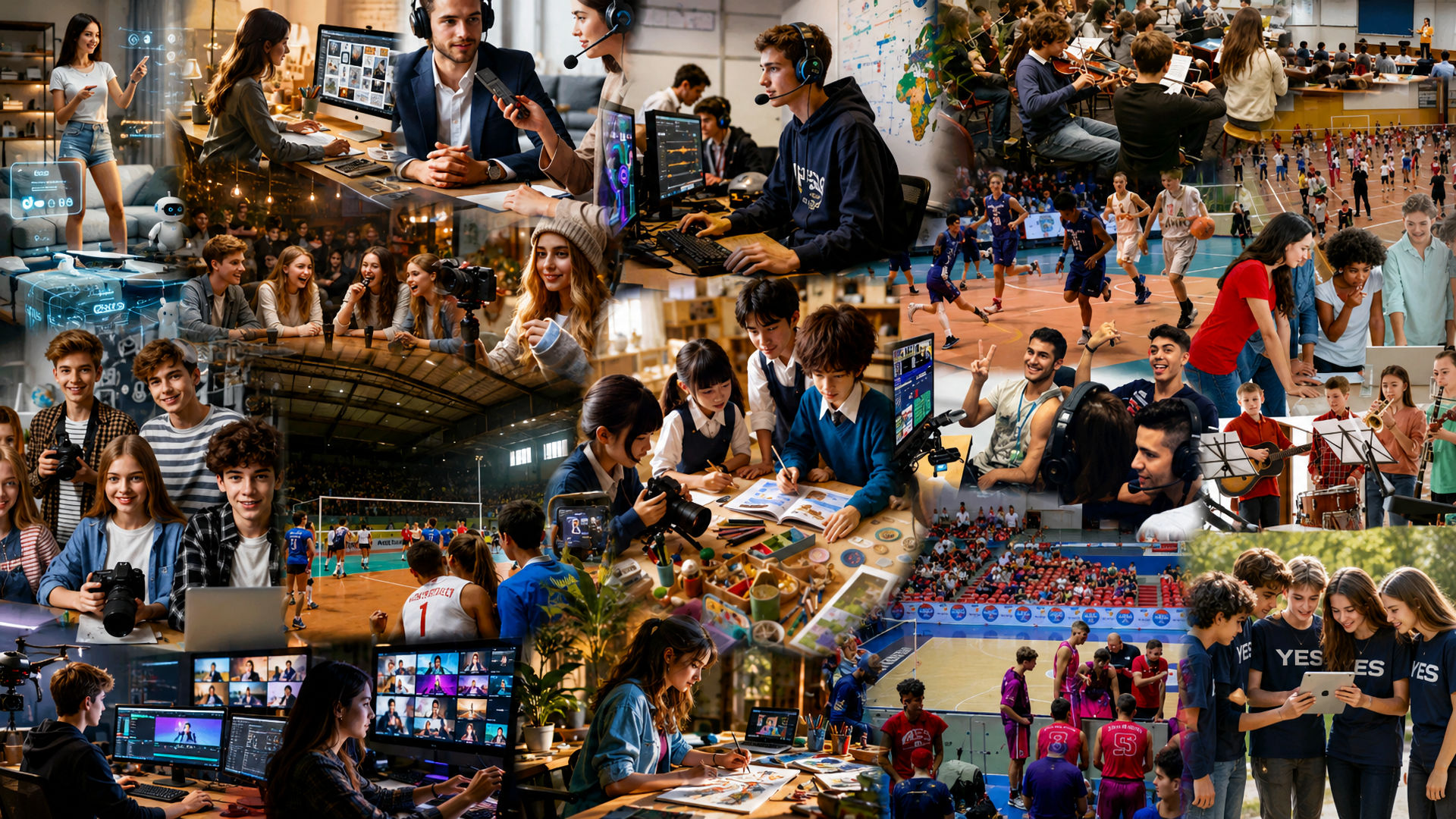
By way of example, YES formats cover meetings, projects, communication, digital content, recruitment, interviews, negotiation, sport, citizenship, conflict management, event organisation and collaborative work. These examples do not define the limits of the method; they illustrate only some of its possible applications.
Yes Meeting Challenge
Simulated meetings, active listening, comparison of viewpoints, time management, reasoned argument and shared decision-making.
Yes Project Challenge
Project development, feasibility analysis, operational planning, team organisation, presentation and evaluation of the idea.
Yes Advertising Agency
Creativity, communication, promotional messaging, visual design, slogans, advertising campaigns and the ability to attract attention.
Yes Digital Channel
Content production, editorial planning, digital communication, video, written materials, interviews and the management of an information channel.
Yes Recruiting Challenge
CVs, interviews, selection, negotiation, personal presentation, assessment of value and understanding of roles.
Yes Trade
A competition designed for younger participants that develops negotiation, collaboration and work organisation, inspired by international trade.
Yes Augmented Reality
Competitions that encourage teamwork through the engaging use of Augmented Reality, across a wide range of subjects, including school topics.
Yes Tournament
Participation in a real sporting event, including its organisation and preparation (training, interviews, live commentary, promotion and hospitality).
Radio/TV streaming
Creation of a YouTube channel featuring planned and structured live broadcasts on a wide range of topics.
Yes Editing
The organised and structured production of finished publications such as magazines, children's books and photographic journals.
Yes Social conflict
A broad range of realistic conflict situations that teams must address with the support of interactive AI, encouraging reflection and collective reasoning.
Yes-Library Open
...the list is potentially unlimited and open to contributions from external partners ...
From One Experience to Skills for Life
The greatest value of YES emerges through progressive repetition. Young people do not develop leadership, communication skills, independence, responsibility or critical thinking through a single, time-limited experience. These skills are built through recurring experiences, varied contexts, feedback, comparison and repeated opportunities to improve.
The method makes it possible to offer different experiences over time while maintaining a consistent framework: observing, objectively measuring and recording how each young person participates, collaborates, addresses difficulties, communicates, plans, changes behaviour and improves in comparison with previous experiences.
This continuity makes YES more like educational training than an isolated event. The game is the playing field; the method is the training programme; the platform helps preserve evidence, compare experiences and support reflection on progress over time.
Evidence, Reflection and Progressive Monitoring
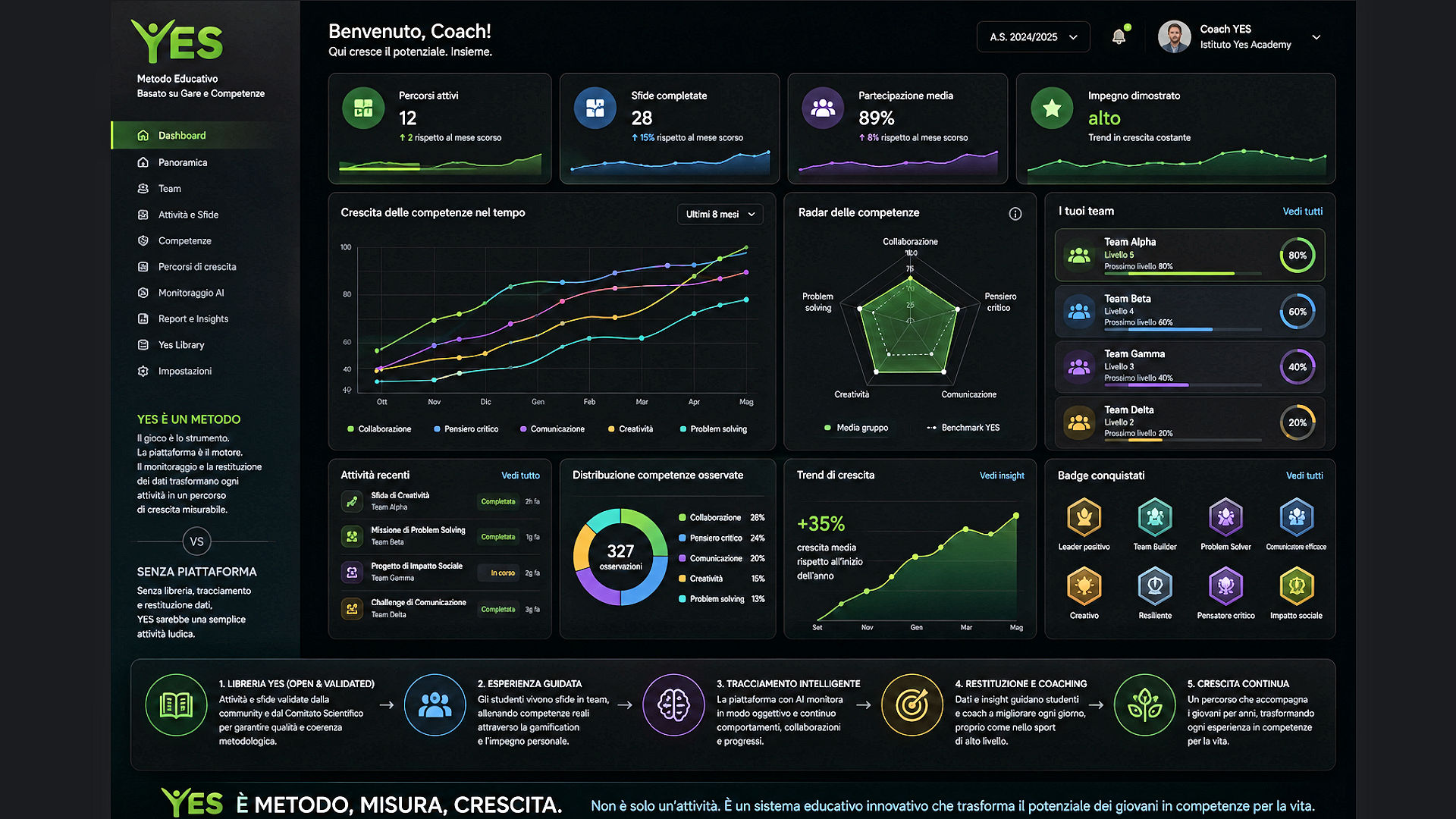
Monitoring is one of YES's defining features. The platform collects evidence of the work carried out: time taken, assignments, responses, choices, completed outputs, participation levels, quality of ideas, originality, consistency, collaboration, reasoning skills and improvement over time.
This does not mean turning the experience into an examination. On the contrary, it makes visible what often remains unseen: how young people organise themselves, discuss issues, divide tasks, respond to obstacles and learn from experience.
Progressive monitoring helps move beyond impressions by making parts of the learning journey visible and documentable. The purpose is to support feedback, reflection and improvement — not to reduce a young person to a score.
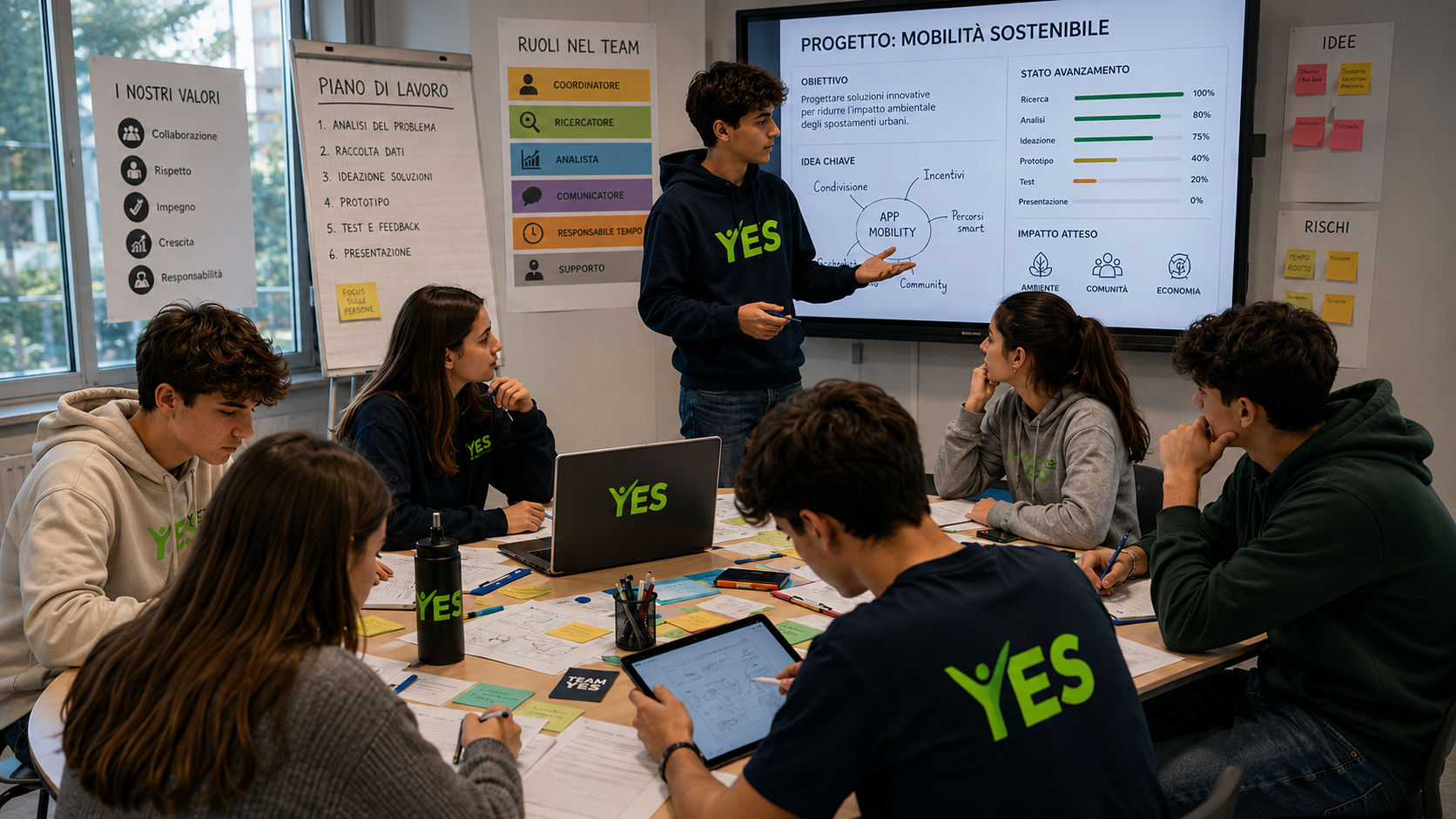
Artificial intelligence is one of the tools available within the YES platform. In some YesGames it can support teams, generate varied scenarios and contribute to the observation of work against predefined criteria. Its role is explicit and governed: young people should be able to understand when AI is being used, question its contribution and reflect critically on its suggestions.
Its role is not to replace educators, teachers or coaches. AI can enrich the learning experience, but some activities can also be carried out without it. Where it is used, it acts as a support tool rather than as an unquestionable evaluator.
In this sense, through its use of artificial intelligence, the platform can be regarded as a digital coach that supports the journey in much the same way as high-level professional sports coaching: performance is observed, historical data are analysed, strengths and areas for improvement are identified, and participants return to training with greater awareness.
Artificial intelligence and the platform therefore provide technical support for instructors, educators and teachers. Automated data observation, technical assessments and system-generated indicators never replace human judgement, which remains the central, indispensable and decisive element of the educational process.
Skills That YES Can Develop
YES programmes can be designed to develop a broad range of transferable, life, social and behavioural skills, always in a way that is appropriate to participants' age, culture and learning context.
- effective communication, public speaking, concise writing and the ability to present an idea;
- collaboration, team building, listening, respect for roles and management of group dynamics;
- leadership, responsibility, independence, initiative and the ability to motivate others;
- problem-solving, rational analysis, choosing between alternatives and managing constraints;
- critical thinking and the ability to assess consequences, risks, opportunities and the consistency of decisions;
- creativity, visual communication and the design of content, logos, slogans, materials and messages;
- negotiation, mediation, conflict management and the search for shared solutions;
- career guidance, self-awareness and the ability to recognise strengths and areas for improvement;
- digital literacy, responsible use of technology and an understanding of the role of artificial intelligence.
A Practical Framework for Educators and Facilitators
YES can be used by teachers, educators, coaches and facilitators across many subjects and youth-development settings. Language, citizenship, technology, art, digital learning, sport, communication, economics and project-based activities can all become practical settings in which knowledge is applied while teamwork and transferable skills are exercised.
The method links practical activities with subject content: writing a text, creating an invitation, designing a logo, planning a campaign, organising an event, simulating an interview, conducting an interview, analysing a problem, presenting a solution, assessing costs, timing and outcomes, and answering questions or quizzes on a wide range of topics—all while organising the group and allocating responsibilities.
Its value lies in providing an interdisciplinary, motivating and documentable environment in which skills can be observed while they are being put into practice.
From this perspective, schools and YES can work together in much the same way as sport. Sport, in fact, does more than strengthen the body and promote good health: through commitment, discipline, respect for rules, cooperation and teamwork, it also helps develop essential transversal skills.
In the same way, schools provide knowledge and cultural foundations, while YES creates practical opportunities in which that knowledge can be applied alongside the soft skills needed to organize, make decisions, collaborate, take responsibility and work towards a shared goal.
YES and Development: From Participation to Awareness
Young people often participate enthusiastically when they perceive an activity as a challenge, a competition, a game, a simulation or a mission. YES channels this initial energy towards greater awareness: What did I do? How did I collaborate? What did I communicate? Where did I make a difference? Where can I improve? Which role comes naturally to me, and which role do I need to learn to manage?
This transition from participation to awareness is central. The method does more than involve young people in activities; it helps them understand the educational meaning of what they have done.
YES Does Not Replace Educators: It Supports Them
YES does not seek to replace the educational relationship. Teachers, tutors, coaches, instructors and other trusted adults remain essential. The platform and artificial intelligence provide tools for support, organisation, observation and feedback, but the educational value remains rooted in the human context in which the programme takes place.
The strength of the method lies precisely in the integration of real-world experience, adult guidance, technology, educational AI, the programme library and progressive monitoring.
Official YES Logo
The image shown on this page is the official logo of YES - Youth Empowerment Skills.
The logo is more than a brand mark: it identifies a method, a platform and an educational vision founded on experience, continuity, monitoring and the responsible, governed use of technology.
In Summary
YES is an experiential educational method for youth empowerment and the development of transferable skills and life skills.
It uses team challenges to turn participation into learning by doing.
It uses the digital platform to make experiences structured, traceable and repeatable.
It uses educational artificial intelligence, where appropriate, as a governed support tool for activities, feedback and reflection.
It uses YesLibrary to create learning experiences that can be adapted to different ages, cultures, contexts and objectives.
Its value increases through continuity, experience after experience, enabling young people to strengthen skills that can be transferred across education, work, community life, sport and personal relationships.
support@yesthegame.com
Learn more about international partnerships and collaboration opportunities